
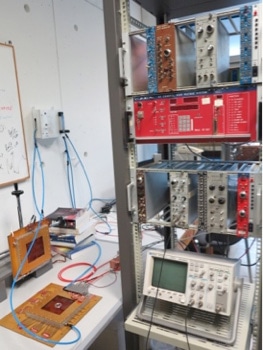
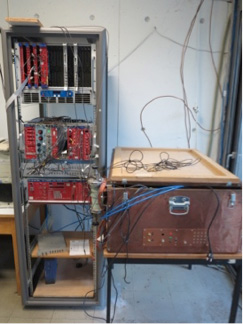
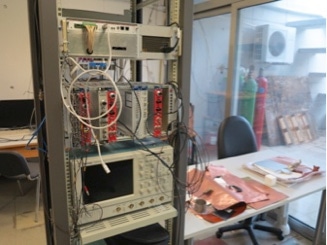
THREE FULLY EQUIPPED TEST BENCHES FOR STUDYING MPGDs
- Gas distribution,
- Electronics Racks with NIM modules, HV modules, preamplifiers, amplifiers etc
- Oscilloscopes
- Workstations
- Radioactive sources
GAS MIXER and distribution of premixed gases
ELECTRONICS AND DAQ SYSTEMS
- VME Data Acquisition (CAEN controller, optical fiber connection
- CRAMS, sequencer, ADC unit, Gate generator, etc)
- SRS - Scalable Readout System (APV FE, 2000 channels readout)
- FEMINOS readout for TPC mode
- Electronics: Racks (1 VME and 4 NIM crates), NIM units
- (Multifunction NIM modules, Amplifiers, Discrim., HV, LV PS
- Pulse generators, NIM/ TTL/ NIM converter etc), MCAs (2), Preamps
DESIGN PACKAGES
- Electronics design packages
- Finite Element Analysis
- DAQ software (Labview, C++)
- FPGA (Altera, Xilinx) design workstations
- FPGA Design platforms
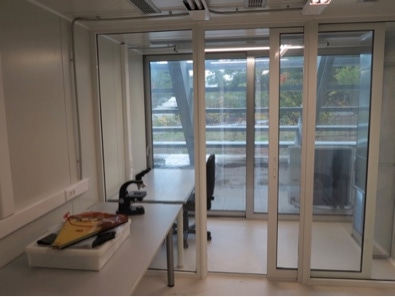
CLEAN ROOM
- (12 m2 – two rooms Class 10,000 and Class 100,000)
- Microscope

The DAMA Instrumentation Laboratory
The Data Acquisition Monitoring and Analysis (DAMA) instrumentation Laboratory aims at:
- Innovative R&D on Micro Pattern Gaseous Detectors – MPGDs
- Development of MPGD related electronics and DAQ systems
- Dedicated detectors for HEP, Nuclear Physics and applications
DAMA operates since 2000 and its main emphasis is the development of innovative MPGD and in particular Micromegas detectors.
DAMA was the first Laboratory to introduce the Micromegas technology in Greece (2001), promoted their use to the Greek academic community and initiated the most established to date biennial International Conference on MPGDs: “1st International Conference on Micro Pattern Gaseous Detectors – MPGD2009”, Kolympari, Crete and was followed by MPGD2011, Kobe, Japan, MPGD2013, Zaragoza, Spain, MPGD2015, Trieste, Italy, MPGD2017, Philadelphia, USA and MPGD2019, La Rochelle, France.
Micro Pattern detectors can adapt to detect practically any kind of radiation: charged particle like cosmic muons, alphas, nuclei, neutrons, X-rays, visible photons and complement other types of detectors with their unique properties. A particular example is the measurement of the X-ray polarization at energies 1 – 10 keV, that can be performed thanks to the possibility for photoelectron tracking in the gas. This application can be used for X-ray polarimetry in Astronomy as well as in nuclear fusion as a tool to map the electric field in the core of the torus.
DAMA Infrastructure (Link to Text 1)
Current Research Activities (Link to Text 2)
Past Research Activities (Link to Text 3)
DAMA Infrastructure (Text 1)
The DAMA Laboratory is located in the ground floor of the INPP Tandem building and occupies an area of about 60 m2. The main infrastructure is shown below:
-
THREE FULLY EQUIPPED TEST
-
BENCHES FOR STUDYING MPGDs
-
Gas distribution,
-
Electronics Racks with NIM modules, HV modules, preamplifiers, amplifiers etc
-
Oscilloscopes
-
Workstations
-
Radioactive sources
-
GAS MIXER and distribution of premixed gases
-
ELECTRONICS AND DAQ SYSTEMS
-
VME Data Acquisition (CAEN controller, optical fiber connection
-
CRAMS, sequencer, ADC unit, Gate generator, etc)
-
SRS – Scalable Readout System (APV FE, 2000 channels readout)
-
FEMINOS readout for TPC mode
-
Electronics: Racks (1 VME and 4 NIM crates), NIM units
-
(Multifunction NIM modules, Amplifiers, Discrim., HV, LV PS
-
Pulse generators, NIM/ TTL/ NIM converter etc), MCAs (2), Preamps
-
DESIGN PACKAGES
-
Electronics design packages
-
Finite Element Analysis
-
DAQ software (Labview, C++)
-
FPGA (Altera, Xilinx) design workstations
-
FPGA Design platforms
-
CLEAN ROOM
-
(12 m2 – two rooms Class 10,000 and Class 100,000)
-
Microscope
DAMA Current Research Activities (Text 2)
The main activity of the DAMA Laboratory is currently within the ATLAS collaboration and it is described in a separate page.
The INPP/ATLAS group activities (link to ATLAS page)
Ongoing R&D activities are performed on highly promising developments.
Resistive Bulk Micromegas for High Rate applications
Collaboration: NCSR Demokritos, LAPP Annecy, CEA Saclay
Detector operation at very high rates is required by experiments in future accelerators like the High Luminosity LHC (HL-LHC), the International Linear Colliders (ILC) or in the Future Circular Collider (FCC). They can be used in high granularity Particle Flow (PF) hadron calorimeters with small thickness at ultra high rates thanks to their discharge quenching. They are also good candidates for operation at high eta at the HL-LHC where they can withstand rates of 10s of MHz/cm2.
Our R&D has proven the excellent linearity for the buried resistor technique as well as their excellent behavior concerning spark quenching. The figure shows the model of the buried resistor technique. The photo shows the irradiation setup in DAMA Lab for the linearity tests of the detector.
Further development is performed in the frame of the RD51 Common Fund project “Sampling Calorimetry with Resistive Anode MPGDs” – SCREAM. It is a collaboration of six institutions: LAPP Annecy, Weizmann Institute of Science, INPP/NCSR Demokritos, CEA/IRFU Saclay, University of Aveiro and University of Coimbra aiming to develop MPGD technologies appropriate for hadron sampling calorimeters for the ILC but will also provide valuable tests for the operation of MPGDs at very high rates.
Conferences/Publications
- M. Chefdeville et al., Test in a beam of large area Micromegas chambers for sampling calorimetry, NIMA 763 (2014) 221231.
- M. Chefdeville, T. Geralis, M. Titov, Resistive Micromegas for sampling calorimetry, a study of space charge effect, Proceedings of Elba proceedings, Nucl.Instrum.Meth. A824(2016) 510-511.
- Resistive Micromegas for sampling calorimetry, a study of charge-up effects
M. Chefdeville, Y. Karyotakis, T. Geralis, M. Titov. 2016. 2 pp.
Published in Nucl.Instrum.Meth. A824 (2016) 510-511 - T. Geralis et al., ‘Development of resistive anode Micromegas for sampling calorimetry’, Proceedings of the MPGD2015 conference in EPJ Web of Conf., 174, 01017 (2018).
Real x-y Segmented Mesh Microbulk Micromegas
Collaboration of INPP/NCSR Demokritos, CEA/IRFY Saclay, University of Zaragoza and CERN.
The Aim of the project is to develop microbulk Micromegas detectors with real x-y structure by segmenting the mesh. The old fashioned way to provide x and y information was a complicated pcb structure with pads on the anode surface and through metalized holes in order to form conductive y strips on a layer beneath the anode. The manufacturing procedure was difficult and fragile with the disadvantage of higher material budget. The new manufacturing process is simpler and leads to mass minimization, which is adequate for rare searches applications but also for neutron beam profilers. Our group proposed and coordinated the effort on the optimization and the design of the Real x-y segmented mesh microbulk Micromegas, which was supported by the RD51 Common Fund.
The performance for the energy resolution is impressive and reaches an optimum for a gaseous detector of 11% FWHM at 5.9 keV (see figure).
Real x-y segmented mesh microbulk Micromegas is very adequate for Rare searches like axion or dark matter thanks to the very low background that can be achieved (~ 10-7 cnts/keV/cm2/s) with its low material budget and additional measures like, low radioactivity shielding, cosmic veto etc.
It is already used in the nTOF collaboration for a neutron beam profiler with excellent results. This is the thinnest neutron detector ever manufactured with only 5 μm + 5 μm of Cu and the remaining polyimide in betwwen the x and y foils.
Conferences/Publications
-
T. Geralis et al. ‘A real x-y Microbulk Micromegas with segmented mesh’, PoS (TIPP2014)055.
-
M. Diakaki et al., ‘A novel segmented mesh Micromegas detector development for neutron beam profiling’, Submitted to NIMA.
Micromegas Using micro fabrication Techniques and Graphene
Collaboration: INPP/NCSR Demokritos, INN/NCSR Demokritos
Our primary goal and ambition is to build a Micromegas detector operating with two different gases in the conversion volume and the amplification volume. This idea and the progress towards this goal was presented by our group for a first time at the MPGD2015 in Trieste.
Text 3 (coming)