HEP-theory

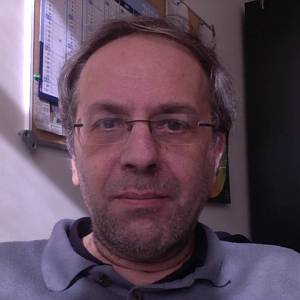
Nikos Dokmetzoglou joined the HEP Theory group of the Institute of Nuclear and Particle Physics at the National Centre for Scientific Research “Demokritos” as a postdoctoral researcher in 2023. His current objective is to analytically express all five-point two-loop Master Integrals with one off-shell leg and to provide computational tools for their efficient numerical evaluation, making use of the so-called Simplified Differential Equations approach. The results of his work will be integrated within HELAC-2LOOP, an automated framework for the evaluation of two-loop scattering amplitudes, currently being developed at NCSR “Demokritos” as part of the HOCTools-II project led by Prof. Costas Papadopoulos.
Education
- Ph.D. in Physics, University of North Carolina at Chapel Hill, 2023
- Dissertation: “Conformal Yangian and Tree Amplitudes in Scalar and Gauge Field Theories”
- Advisor: Prof. Louise Dolan
- M.Sc. in Physics, University of North Carolina at Chapel Hill, 2019
- M.Sc. in Physics, Davidson College, 2017
Research
Nikos's research focuses on the symmetries and other fascinating mathematical aspects of scattering amplitudes, the ways those can be exploited for pushing the state of the art in amplitude calculations, and their implications for non-supersymmetric field theories, collider physics and the universe at large.
During his graduate studies, he worked with Prof. Louise Dolan on the infinite-dimensional Yangian extension of the conformal algebra, Y[so(2, n)], where n is the number of space-time dimensions, and its action on the tree amplitudes of scalar ϕ3 theory and pure Yang-Mills theory, two non-supersymmetric field theories which are known to be conformally invariant at tree-level in n=6 and n=4 space-time dimensions, respectively. With this work he addressed the (largely still open) questions of how infinite-dimensional algebras act on non-supersymmetric field theories, and what we can learn about the action of the superconformal Yangian, Y[psu(2, 2|4)], on pure gluon tree amplitudes by decoupling the role of the ordinary conformal so(2, 4) generators from that of the supersymmetry ones.
Towards the end of his PhD, he briefly joined the quantum field theory and scattering amplitudes group of the Max Planck Institute for Physics in Munich, led by Prof. Johannes Henn, where, in collaboration with him and Dr. Julian Miczajka, he began an (ongoing) investigation on the remnants of conformal symmetry in loop-level scattering amplitudes, with the goal of better understanding the structure of the algebraic coefficients appearing in the decomposition of loop amplitudes into a basis of scalar integrals.
Publications
- N. Dokmetzoglou and L. Dolan, Properties of the Conformal Yangian in Scalar and Gauge Field Theories, JHEP 02 (2023) 137 [arXiv: 2207.14806 [hep-th]].
- N. Dokmetzoglou, ConformalYangian: a Mathematica Package for Computations Related to the Action of the Conformal Yangian Y[SO(2,n)], in preparation.
An up-to-date list of his publications can be found on INSPIRE.
Personal Website: https://nikosdokmetzoglou.github.io/


Aris Spourdalakis completed his undergraduate degree at the University of Athens, where he worked on variational approaches to continuity equations. He completed a MSc at the University of Toronto with a focus on high energy theory. He graduated with a PhD from the University of Toronto, with work focusing on the foundations of Effective Field Theories for Jet physics. He has also worked on machine learning methods for anomaly detection in a QCD background. He is currently working with the HOCTOOLS group at the NCSR-"Demokritos". In all of his research, the underlying theme is the precision determination of the Standard model background, which will allow the search for BSM physics in the precision frontier. He is also active in the teaching and communication of physics to various post-secondary audiences.
List of publications:- Aris G. B. Spourdalakis, George Pappas, Christian V. Morfonios, Panayotis A. Kalozoumis, Fotis K. Diakonos, Peter Schmelcher “Generalized continuity equations from two-field Schrödinger Lagrangians”, Phys. Rev. A 94, 052122 (2016)
- Matthew Inglis Whallen, Michael Luke, Aris G. B. Spourdalakis “Rapidity Logarithms in SCET Without Modes”, arXiv:2005.13063, DOI: 10.1103/PhysRevD.104.076018
- Matthew Inglis Whallen, Michael Luke, Jyotirmoy Roy, Aris G. B. Spourdalakis “Factorization of power corrections in the Drell-Yan process in EFT”, arXiv:2105.09277, DOI:10.1103/PhysRevD.104.076018
- Jared Barron, David Curtin, Gregor Kaszieckza, Tilman Plehn, Aris G. B. Spourdalakis, “Unsupervised Hadronic SUEP at the LHC”, arXiv: 2107.12379, DOI: 10.1007/JHEP12(2021)129
- Michael Luke, Jyotirmoy Roy, Aris G. B. Spourdalakis “Factorization at Subleading Power in Deep Inelastic Scattering in the x -> 1 limit”, arXiv:2210.02529 DOI: 1103/PhysRevD.107.074023